
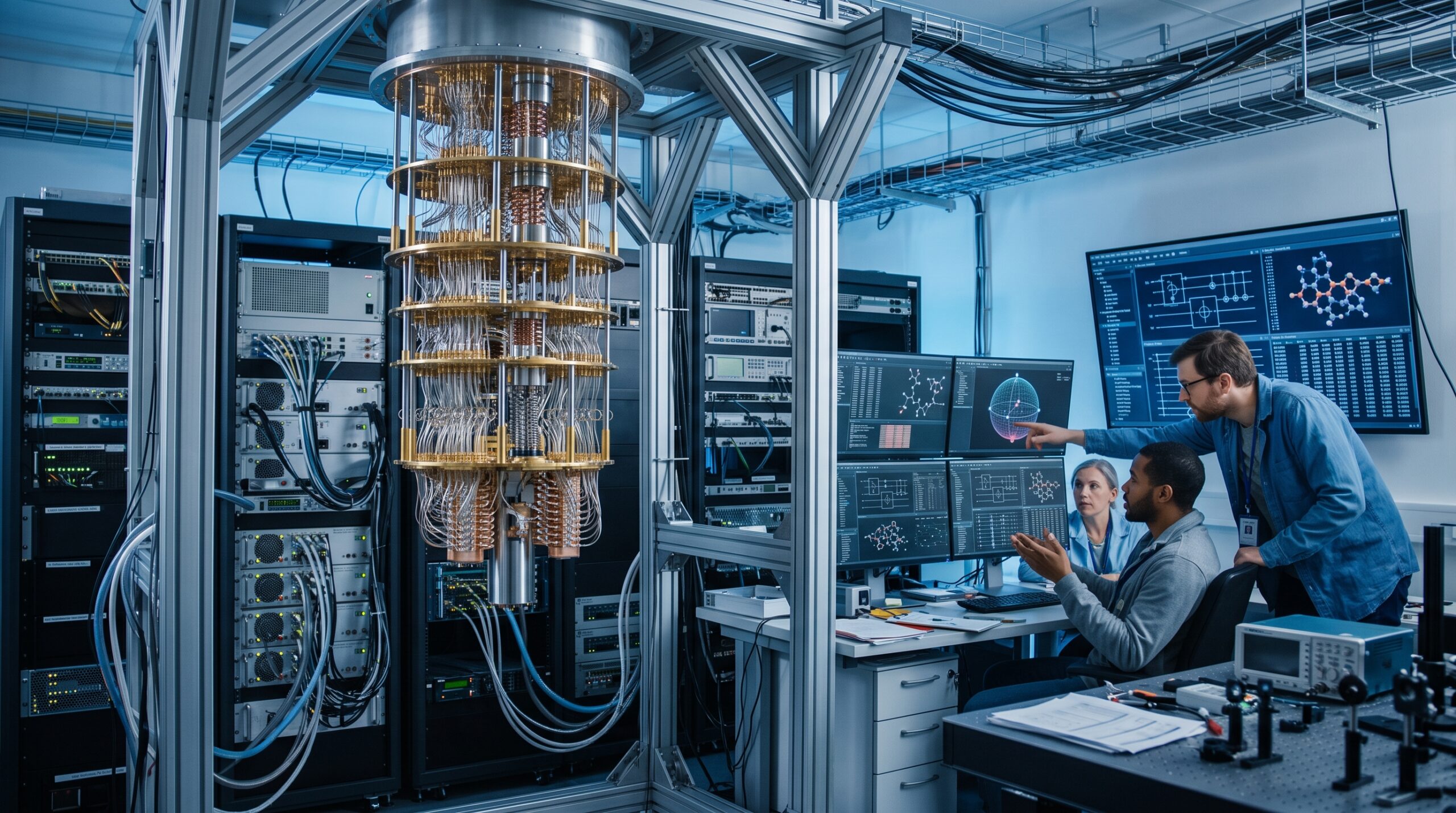
You have seen the headlines for years. Quantum computers will break encryption, design perfect drugs, and solve problems no classical machine can touch. Then you look at the actual devices and see systems that still require extreme cooling, produce noisy results, and need classical computers to do most of the real work. The gap between the promises and the current reality leaves many people unsure what to believe.
That uncertainty is reasonable. Quantum computing is genuinely hard. The physics is subtle, the engineering is demanding, and useful advantage over classical methods arrives unevenly. Yet steady progress in 2026 is changing the picture. Hardware is scaling. Error correction is improving. Hybrid quantum-classical systems are already delivering measurable results on selected problems. The quantum computing future is taking shape through specific scientific and industrial applications rather than a single dramatic takeover of all computing.
This article examines what quantum computing could realistically mean in the coming years. Primary focus stays on the quantum computing future as it moves from laboratory demonstrations toward practical utility. Secondary angles include near-term hybrid applications, chemistry and materials simulation, the cryptography timeline, infrastructure requirements, and what individuals and organizations should watch. The aim is a grounded view that separates genuine potential from overstated claims.
Where Quantum Computing Stands in 2026
Leading systems now operate with hundreds to more than a thousand physical qubits. Error rates continue to fall. Techniques for detecting and correcting errors are advancing, with early logical qubits demonstrating longer lifetimes than the best physical qubits in some experiments. Companies such as IBM, IonQ, Quantinuum, and others have published detailed roadmaps targeting examples of quantum advantage this year and fault-tolerant machines later in the decade.
Advantage here means solving a useful problem faster, more accurately, or at lower total cost than the best practical classical method. Most current value comes from hybrid approaches. Quantum processors handle the parts of a calculation that benefit from quantum effects while classical supercomputers manage the rest. Real deployments already exist in areas such as portfolio optimization, logistics scheduling, and certain simulation tasks.
The technology remains specialized. It is not ready to replace your laptop or the servers that run everyday applications. It is becoming a powerful specialized instrument for problems that map well to quantum principles.
Chemistry, Materials, and Drug Discovery Lead the Near-Term Opportunities
The most promising near-term applications sit in simulating molecules and materials. Classical computers struggle with the quantum behavior of electrons in complex systems. Quantum processors are naturally suited to those calculations.
In drug discovery this can mean faster identification of promising candidates and better understanding of how molecules interact. In materials science it can accelerate the design of better batteries, catalysts, superconductors, and other advanced materials. Several pharmaceutical and chemical companies are already running pilot projects. National laboratories and research groups are using hybrid systems to model protein complexes and reaction mechanisms that were previously out of reach at useful accuracy.
These applications will not suddenly make every drug cheap or every material perfect. They will shorten certain research cycles and open design spaces that classical methods explore too slowly. The organizations that learn to integrate quantum simulation into their existing discovery pipelines stand to gain an edge.
Cryptography Faces a Long but Real Transition
One of the most discussed implications is the threat to current public-key encryption. A sufficiently large and reliable quantum computer could break widely used systems such as RSA and elliptic-curve cryptography. Estimates for when a cryptographically relevant machine will appear still range from roughly a decade to longer, depending on the source and assumptions.
The practical response is already under way. NIST has standardized post-quantum algorithms. Organizations that handle long-lived sensitive data are beginning migration planning. The risk is not only future decryption of today’s traffic. Data encrypted now can be stored and decrypted later once capable quantum machines exist. That “harvest now, decrypt later” threat makes early preparation rational for high-value information.
For most individuals the immediate impact is limited. For governments, financial institutions, healthcare providers, and companies with multi-year confidentiality needs, the transition is a live project. The quantum computing future includes a multi-year cryptographic upgrade cycle running in parallel with hardware progress.
Optimization and Complex Systems Offer Additional Paths to Value
Beyond pure simulation, quantum and quantum-inspired algorithms show promise for certain optimization problems. Portfolio construction, logistics routing, and some scheduling tasks have produced measurable improvements in pilot settings. Telecom network modeling and engineering simulation have also shown early results when quantum resources are combined with classical methods.
These gains remain problem-specific. Not every optimization task will benefit. The ones that do tend to involve large combinatorial spaces where quantum effects or specialized quantum-inspired classical algorithms provide an edge. Companies that identify the right subset of their problems and build the surrounding classical infrastructure will extract value first.
Infrastructure, Talent, and Hybrid Architectures Will Determine Speed of Progress
Quantum computers require specialized environments. Many need temperatures near absolute zero. Control systems, error-correction decoding, and classical integration add layers of complexity. Progress depends as much on engineering and software as on raw qubit counts.
Talent is another constraint. The field needs people who understand both the quantum hardware and the domain problems it might solve. Universities, national labs, and companies are expanding training, yet demand still outpaces supply in key areas.
The dominant architecture for the next several years will be hybrid. Quantum processors will sit alongside high-performance classical computers. Software tools that automatically decide which parts of a workload belong on which type of hardware are becoming more important. Organizations that treat quantum as one specialized resource inside a broader computing strategy will move faster than those waiting for a fully standalone quantum replacement.
What This Means for Different Groups
For researchers in chemistry, materials, and related fields, quantum computing is becoming a tool worth learning. Early familiarity with hybrid workflows and quantum algorithms can open new research directions.
For businesses in pharmaceuticals, chemicals, finance, logistics, and advanced manufacturing, the rational approach is selective experimentation. Identify one or two high-value problems that map to quantum strengths, run structured pilots, and measure results against classical baselines. Most companies do not need to build their own hardware. Cloud access and partnerships provide lower-risk entry points.
For policymakers and security professionals, the cryptography transition deserves steady attention. Inventory systems that rely on vulnerable algorithms and plan migration timelines that match the sensitivity and lifespan of the data involved.
For everyone else, the main effect over the next few years will be indirect. Better materials, faster drug development cycles, and improved optimization in supply chains will appear as ordinary improvements in products and services. Direct interaction with quantum hardware will remain limited to specialists.
A Realistic Outlook and What to Watch
Quantum computing will not transform every industry overnight. It will deliver growing utility on a defined set of hard problems while classical computing continues to handle the vast majority of workloads. The most important near-term milestones are demonstrations of clear advantage on scientifically or commercially relevant tasks, continued reduction in error rates, and progress toward fault-tolerant architectures.
Watch the roadmaps of major providers for logical qubit counts and error rates. Follow pilot results in chemistry and optimization that publish clear comparisons with classical methods. Track the adoption of post-quantum cryptography standards in critical systems.
The quantum computing future is being built through incremental engineering progress and careful matching of problems to capabilities. Those who approach it with clear-eyed expectations and focused experimentation will be best positioned to benefit as the technology matures. Start by understanding which of your challenges, if any, sit in the domains where quantum methods already show promise. That focused curiosity is the most practical step available right now.
FAQ
Is quantum computing useful today?
Yes, for selected problems through hybrid quantum-classical systems. Broad advantage over classical computing on general tasks is still developing.
When will quantum computers break current encryption?
Estimates vary, but a cryptographically relevant machine is generally expected on a timeline of roughly a decade or more. Migration to post-quantum algorithms is already under way for high-value systems.
Which industries are closest to benefiting?
Chemistry, materials science, pharmaceuticals, and certain optimization-heavy fields such as finance and logistics are the most active areas of experimentation.
Do I need to understand quantum physics to benefit from the technology?
No. Most users will access quantum capabilities through cloud services and specialized software. Domain experts who can frame problems clearly will extract the most value.
What should organizations do right now?
Identify one or two high-potential use cases, run measured pilots against classical baselines, and begin post-quantum cryptography planning for long-lived sensitive data.
Leave a Reply