
You have heard the grand claims for years. Artificial intelligence will change everything. Some days it feels true. Other days it feels like another round of overpromising. The gap between the headlines and your daily experience creates a quiet frustration. You see impressive demos, yet many tools still require constant babysitting or deliver only marginal gains.
That frustration is understandable. The real story in 2026 is quieter and more concrete. Artificial intelligence is no longer just answering questions or generating text. It is taking on end-to-end work, stepping into the physical world, accelerating scientific discovery, and reshaping how software itself gets built. The future of artificial intelligence is arriving through practical systems that already handle real tasks rather than through a single dramatic leap.
This piece examines how artificial intelligence is building the future across the areas that matter most right now. Primary focus stays on the future of artificial intelligence as it moves from tools to systems that act. Secondary angles include agentic systems, physical AI and robotics, AI-driven scientific progress, infrastructure demands, and the practical steps individuals and organizations can take to benefit. The goal is clear-eyed understanding rather than hype.
Agentic Systems Are Moving from Assistants to Co-Workers
The biggest shift you will feel first is the rise of agentic AI. Earlier tools waited for your next prompt. Current systems can plan multi-step work, use tools, check their own results, and hand tasks to other specialized agents.
Gartner and McKinsey both highlight multiagent systems as a core trend for 2026. One agent researches. Another drafts. A third verifies compliance or runs tests. A fourth executes the final action inside approved boundaries. Humans set the goals and review the outcomes. The daily experience changes from constant direction to periodic oversight.
In software development the effect is already visible. Teams using AI-native platforms report that smaller groups can match or exceed the output of larger ones. Agents handle routine coding, testing, and documentation while people focus on architecture and judgment. Similar patterns are appearing in customer operations, research workflows, and administrative processes.
The practical implication for you is straightforward. The value of AI is shifting from clever answers to reliable completion of defined work. Learning to define clear goals, set boundaries, and review results becomes a core skill.
Physical AI Brings Intelligence into the Real World
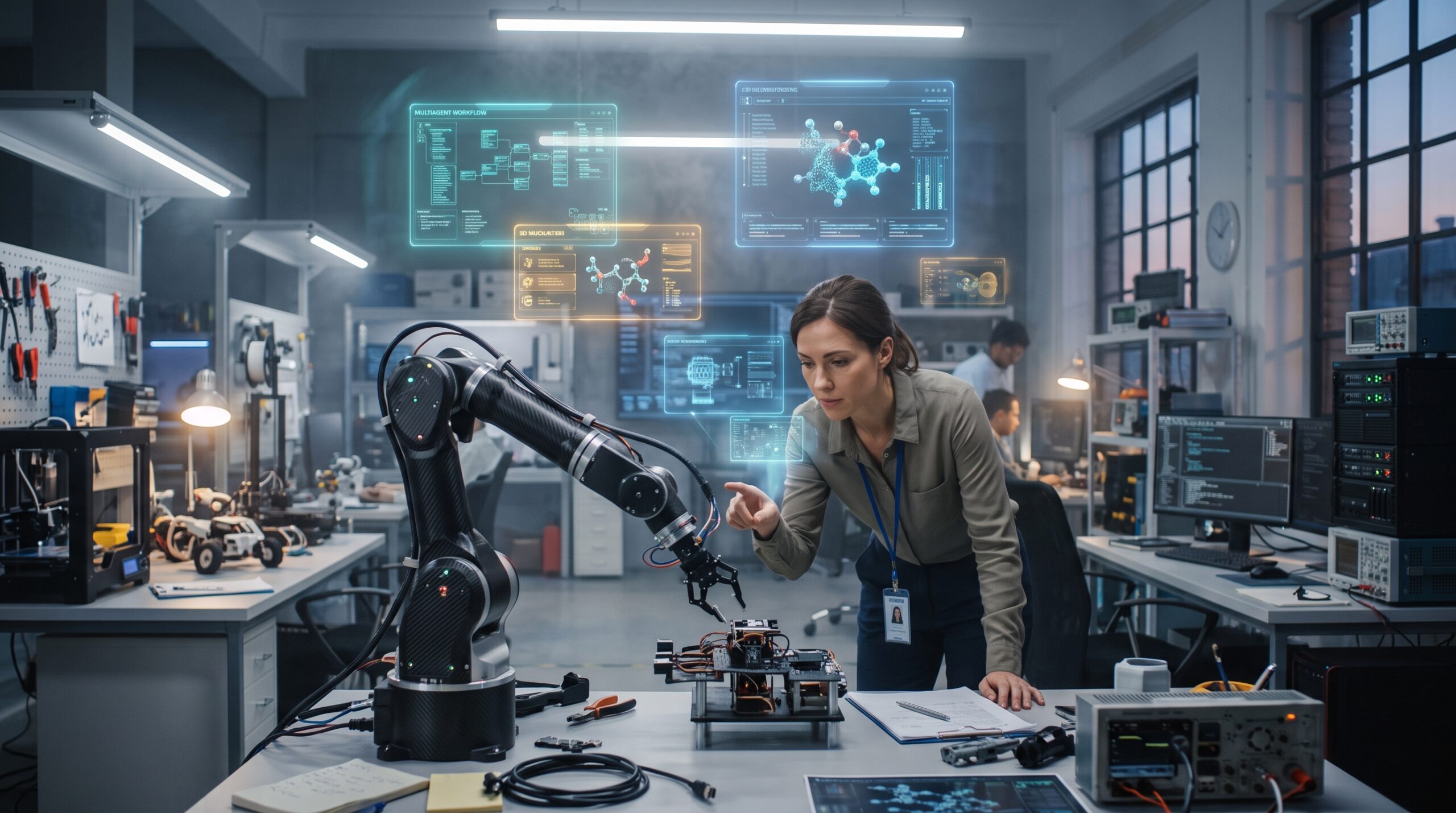
Software AI transformed screens. Physical AI is transforming factories, warehouses, hospitals, and eventually homes. Robots and autonomous systems are gaining the ability to perceive changing conditions, reason about next steps, and act with less pre-programming.
Advances in vision models, multimodal understanding, and learning from demonstration are shortening the time it takes to teach new physical skills. Some systems can adapt to new robot bodies with limited examples. Others learn long-horizon tasks from a single video of a human performing the work. Manufacturers are already deploying these capabilities for welding, assembly, inspection, and material handling.
The rollout will be gradual. Specialized robots in controlled environments will scale faster than general-purpose humanoids in open settings. Still, the direction is clear. Tasks that were once too variable or unpredictable for automation are becoming reachable. Labor shortages in certain industries are accelerating adoption.
For most people the near-term impact will appear as more reliable delivery, faster production of goods, and new assistive devices. Over a longer horizon the same technologies will reshape logistics, construction, and elder care.
AI Is Accelerating Scientific Discovery and Engineering
One of the highest-leverage applications is using AI to speed up the cycle of hypothesis, experiment, and refinement. In drug discovery, materials science, and engineering design, models now propose candidates, predict properties, and suggest the next experiments.
The result is shorter timelines for certain classes of problems. Life sciences companies report faster identification of promising compounds. Materials researchers explore larger design spaces than classical methods allowed. Engineering teams simulate and optimize systems before physical prototypes are built.
This does not replace scientists or engineers. It multiplies their reach. The people who learn to work effectively with these systems will tackle problems that previously sat outside practical reach. The broader effect is faster progress on energy materials, medical treatments, and complex engineered systems.
Infrastructure and Energy Constraints Shape What Is Possible
None of this progress is free. Training and running advanced models require enormous computing power and electricity. Data center demand has pushed energy and cooling to the center of strategic planning.
Companies are responding with more efficient model architectures, specialized hardware, and hybrid approaches that mix large frontier models with smaller domain-specific ones. The cost of achieving a given level of performance has fallen sharply over recent years, making more applications economically viable. At the same time, the absolute scale of deployment continues to grow.
The practical consequence is that location, power availability, and efficiency matter more than ever. Organizations that treat energy and infrastructure as core constraints rather than afterthoughts will move faster. Individuals will notice the effects through the availability and cost of advanced AI services.
Domain-Specific and Specialized Models Are Taking Center Stage
General-purpose models remain powerful. Many of the highest-value applications in 2026 use models tuned for particular domains. Legal, medical, engineering, and scientific models trained on high-quality specialized data often outperform broader systems on the tasks that matter inside those fields.
Enterprises are also building internal systems that combine multiple models with proprietary data and tools. Leadership in AI is shifting from who has the single best general model to who can orchestrate the right combination of models, data, and workflows for specific outcomes.
For individuals this means the most useful AI tools will increasingly feel tailored. A coding assistant that understands your codebase, a research tool grounded in your field’s literature, or a planning system connected to your actual calendars and documents will deliver more value than a generic chatbot.
Governance, Trust, and Human Oversight Remain Essential
As systems gain the ability to act, the need for clear boundaries grows. Organizations are developing policies for what agents may do autonomously, when human approval is required, and how decisions are audited. Individuals face parallel questions about which tools to trust with access to email, calendars, or financial accounts.
The most effective approach treats AI systems like capable but fallible colleagues. You give them scoped authority, require transparency on important steps, and maintain the ability to intervene. Blind trust and total rejection both produce poor results. Thoughtful integration produces leverage.
What You Can Do Starting Now

The future of artificial intelligence is not a distant event. It is being built through the systems already moving into production. You can participate in that building process.
Experiment with agentic tools on low-risk, well-defined tasks. Notice where they save time and where they still need guidance. Follow developments in physical AI if your work involves the physical world. Pay attention to domain-specific tools in your field. Treat energy and infrastructure constraints as real factors rather than abstract concerns.
Most importantly, practice the skills that remain human: defining clear goals, exercising judgment under uncertainty, and deciding what should stay under direct control. Those skills become more valuable as the systems around you grow more capable.
Artificial intelligence is building the future through cumulative practical advances rather than a single breakthrough. The people who learn to work with those advances, set sensible boundaries, and focus on real outcomes will shape what that future feels like. Start with one concrete experiment this week. The compound effect over the next few years will be substantial.
FAQ
What is the biggest practical change AI is driving right now?
The shift from tools that answer questions to agentic systems that can plan and complete multi-step work with human oversight.
How is physical AI different from earlier robots?
Physical AI systems can perceive changing conditions, reason about next actions, and learn new tasks with far less pre-programming than traditional industrial robots.
Will AI replace scientists and engineers?
No. It is accelerating the cycle of discovery and design so that people can tackle larger and more complex problems than before.
Why do energy and infrastructure matter so much for AI progress?
Advanced models require significant computing power and electricity. Efficiency gains and power availability directly affect what applications become practical and affordable.
What skill should individuals focus on as AI systems grow more capable?
The ability to define clear goals, set appropriate boundaries, and exercise judgment when reviewing AI-generated work or actions.
Image Prompt
Leave a Reply