
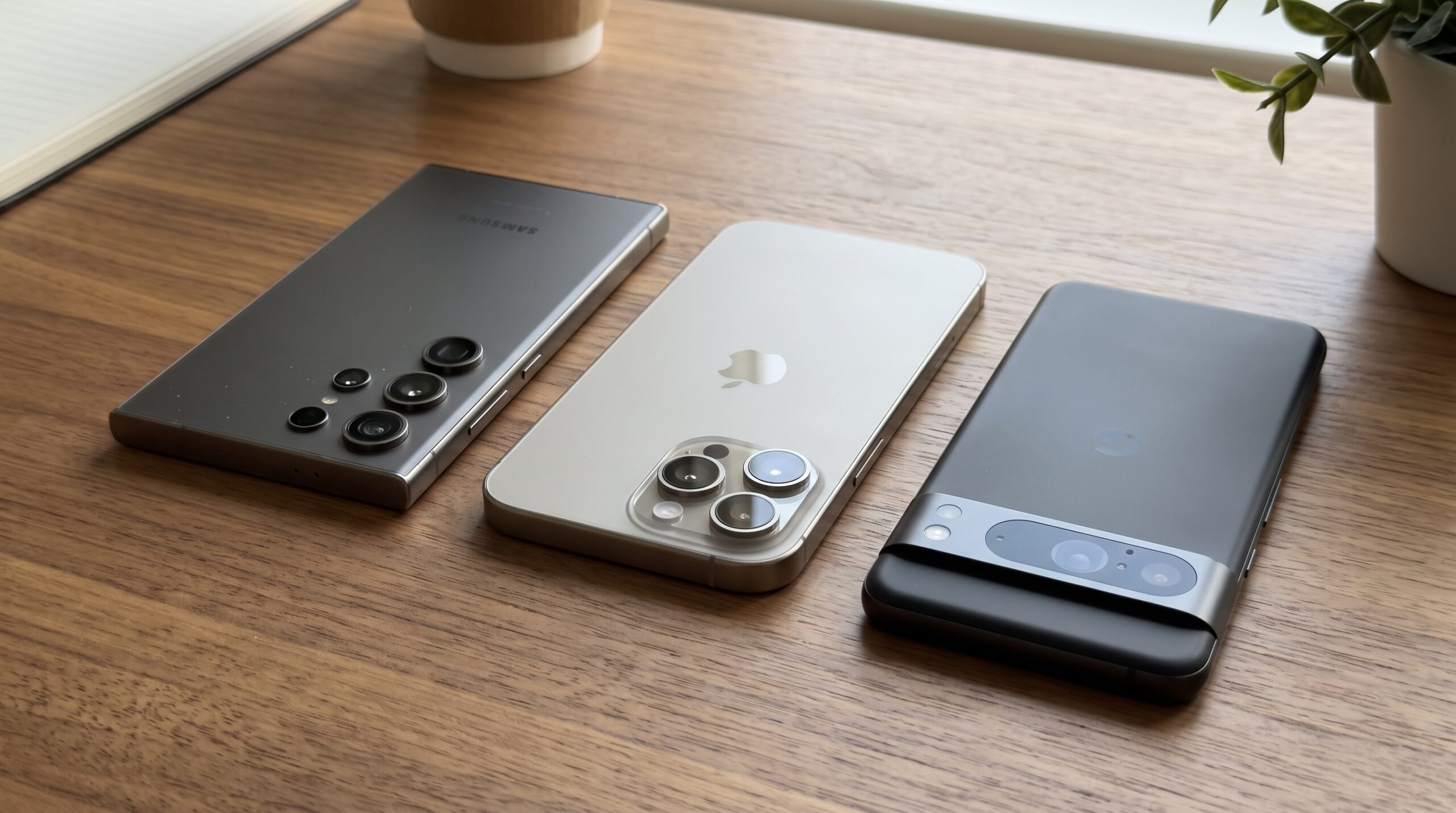
You stand in the store or scroll online and the choice feels heavier every year. Three phones sit at the top of every list, each claiming to be the best, and the differences only show up after weeks of real use. I spent extended time with the current flagship trio—the iPhone 17 series, Galaxy S26 lineup, and Pixel 10 family—to cut through the marketing and show what actually matters day to day. This is the practical comparison that helps you decide which one fits your life.
Design and Build: Size, Weight, and Everyday Feel
All three makers now offer compact and large options. The standard iPhone 17 and Galaxy S26 both sit at 6.3 inches and feel comfortable in one hand. The Galaxy S26 is noticeably lighter at around 167 grams. The iPhone 17 lands closer to 177 grams. The Pixel 10 sits in between but feels slightly thicker.
The Ultra and Pro Max models stretch to 6.8–6.9 inches. The Galaxy S26 Ultra remains the thinnest of the big phones and still includes the S Pen. The iPhone 17 Pro Max adds more weight but delivers the most premium glass-and-metal feel. All three carry IP68 ratings and survive normal drops and rain without drama. After weeks of pocket carry, the lighter Galaxy S26 felt the least tiring for all-day use.
Display Quality Under Real Conditions
Brightness and outdoor visibility separate the good from the great. The Galaxy S26 series reaches the highest peak brightness in most tests, making it easiest to read in direct sunlight. The iPhone 17 panels deliver excellent color accuracy and smooth 120 Hz motion. The Pixel 10 screens are bright enough for most situations and offer clean, natural tones.
For long reading or scrolling sessions the higher refresh rates on all three feel fluid. The Galaxy’s adaptive 1–120 Hz implementation and anti-reflective coating give it a slight edge when you move between indoor and outdoor light. None of these screens will disappoint, yet the Samsung panels still look the most vibrant in mixed lighting.
Performance and Everyday Speed
Raw power is no longer the deciding factor. The Apple A19 and A19 Pro chips remain extremely efficient and handle demanding apps and games without thermal throttling in normal use. The Snapdragon 8 Elite Gen 5 inside the Galaxy S26 series posts the highest multi-core numbers and stays cool under sustained loads. Google’s Tensor G5 prioritizes AI tasks and efficiency over pure benchmark scores.
In daily use the differences shrink. Opening apps, switching between heavy tabs, and editing photos all feel instant on every phone. Gaming at high settings runs smoothly across the board. The Galaxy and iPhone pull ahead when you push sustained workloads for longer periods. The Pixel keeps up for typical tasks and shines when AI features kick in.
Camera Systems in Real Shooting
Camera results still depend heavily on the situation. The Galaxy S26 Ultra’s 200 MP main sensor and versatile zoom range (including a dedicated 5x telephoto) deliver the most flexible stills. Detail at distance and in bright light is excellent. The iPhone 17 Pro series produces the most consistent video and the most natural skin tones for many people. The Pixel 10 Pro continues to lead in computational photography—night shots, HDR, and quick edits often look the most balanced straight out of the camera.
Selfies favor the iPhone’s higher-resolution front camera. Zoom reach goes to the Galaxy. Low-light consistency is a three-way fight that changes with the scene. After hundreds of shots the practical advice is simple: the “best” camera is the one that matches the photos you take most often.
Battery Life and Charging Reality
Battery capacity varies. The Pixel 10 series often posts the strongest endurance numbers thanks to efficient software and larger cells in the Pro models. The Galaxy S26 Ultra with its 5000 mAh battery easily lasts a full heavy day and supports faster wired charging (up to 60 W on some variants). The iPhone 17 Pro Max improved over previous generations and now delivers reliable all-day life with the added benefit of very efficient hardware.
Charging speed still favors Android. The Galaxy and Pixel refill faster from empty. Apple improved wired speeds but remains more conservative. Wireless charging works across all three, with the usual heat and speed trade-offs. For most people any of these phones will survive from morning to night. Heavy users who hate carrying a charger will notice the Pixel and Galaxy advantages first.
Software Experience and Long-Term Support
This is where personal preference becomes decisive. iOS 26 feels polished, private, and tightly integrated with other Apple devices. One UI on the Galaxy S26 offers deep customization, useful productivity tools, and the S Pen on the Ultra. Pixel’s clean Android 16 delivers the fastest feature drops and the most refined AI tools.
All three promise long software support—seven years of major updates is now standard on these flagships. Security patches arrive regularly. The real difference lies in how much you want to tinker. If you like the phone to stay simple and consistent, Apple wins. If you want options and features, Samsung delivers. If you prefer stock Android with smart AI helpers, the Pixel remains the purest experience.
Which Flagship Should You Actually Buy?

Choose the iPhone 17 series if you already live in the Apple ecosystem, value video quality, and want the most predictable long-term experience. Go for the Galaxy S26 Ultra if you want the most versatile camera, the S Pen, the brightest display, and maximum customization. Pick a Pixel 10 Pro if AI features, clean software, strong battery life, and a lower starting price matter most.
Hypothetical example: a photographer who also edits on a laptop found the iPhone 17 Pro Max the smoothest for video work and AirDrop transfers. A productivity-focused user who writes notes and sketches preferred the Galaxy S26 Ultra with its S Pen and DeX mode. A traveler who wanted the best night photos and longest battery between charges settled on the Pixel 10 Pro XL.
None of these phones is weak. The right choice depends on the apps you use daily, the other devices you own, and which compromises you can live with. Spend time with each in a store if possible, check current trade-in values, and buy the one that disappears into your routine instead of demanding attention. That is the real test of a 2026 flagship.
FAQ
Which flagship has the best camera overall in 2026?
It depends on the shot. The Galaxy S26 Ultra leads in zoom flexibility and high-resolution detail. The iPhone 17 Pro series is strongest for video and consistent color. The Pixel 10 Pro often produces the most pleasing computational results in mixed lighting.
How long do these phones last on a single charge?
Most users get a full day of heavy use from any of them. The Pixel 10 Pro models and Galaxy S26 Ultra generally edge ahead in endurance tests, while the iPhone 17 Pro Max improved enough to stay competitive.
Is the extra cost of the Ultra or Pro Max models worth it?
Yes if you want the largest screen, maximum battery, or specialized features like the S Pen or highest storage options. For most people the standard or “plus” sized models deliver nearly the same experience at a lower price.
Which phone receives software updates the longest?
All three current flagship lines promise around seven years of major OS updates plus security patches. Real-world delivery has been reliable across Apple, Samsung, and Google in recent generations.
Should I wait for the next generation?
Only if your current phone still meets your needs. The 2026 flagships already offer excellent cameras, performance, and battery life. Waiting another year usually brings incremental gains rather than transformative ones.
Leave a Reply